In e-commerce, logistics infrastructure is one of the most critical elements directly affecting sales performance. As order volume increases, the question of “where and how will we manage the products?” becomes more strategic. At this point, businesses are faced with two basic models: classic warehousing and fulfillment. The difference between fulfillment and classic warehouse management., This is not limited to operational scope alone. It also involves significant differentiations in terms of speed, cost, scalability, and customer experience. Therefore... fulfillment vs warehousing in e-commerce When making comparisons, the growth objectives of the business must be taken into account.
What is a Classic Storage Tank? What is its purpose?
A traditional warehouse refers to the area where products are physically stored and stockpiled. The warehouse primarily serves a storage function. Product receiving, shelving, and stock management are the main activities. Picking, packaging, and shipping products when orders arrive are often handled manually or with the support of additional personnel.
This structure may initially be sufficient for businesses with low order volumes. However, as the number of orders increases, the classic warehouse model brings with it problems such as operational slowdowns, increased error rates, and uncontrollable costs. At this point, a frequently asked question is: “Is a traditional warehouse sufficient for e-commerce?”The answer to that question can quickly turn to “no,” depending on the scale of the business.
What is fulfillment? How does order fulfillment work?
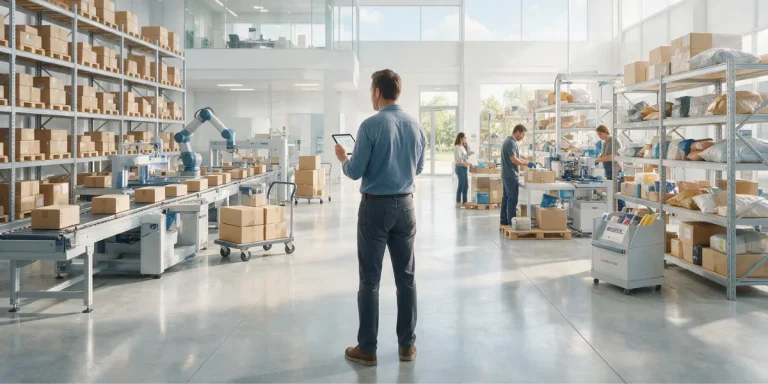
Fulfillment is a holistic model in e-commerce that encompasses not only product storage but also end-to-end order management. Products are received at the fulfillment center, stocked, and when an order arrives, they are collected, packaged, labeled, and shipped via automated systems. Return and exchange processes are also part of the fulfillment service. In this respect, fulfillment... Order fulfillment vs. storage This clearly represents a broader operation. Fulfillment centers typically integrate with WMS, ERP, and e-commerce infrastructures. This reduces human error, increases speed, and standardizes processes.
Where does the difference between fulfillment and classic warehouse begin?
The fundamental difference between the two models lies in service scope and operational depth. A classic warehouse “stores the product,” while fulfillment “manages the order.” As this difference widens, the quality of e-commerce operations changes significantly.
- A traditional warehouse is storage-focused.
- Fulfillment includes warehousing + order preparation + shipping + return management.
- In a traditional warehouse, processes are often carried out manually.
- Automation and system integration are key priorities in fulfillment.
- As traditional warehouses grow larger, the need for staff increases rapidly.
- As fulfillment scales, the unit cost decreases.
At first glance, the fulfillment model might seem more expensive. However, the picture changes when viewed from a total cost perspective. In the classic warehouse model, personnel, packaging, returns due to errors, time loss, and shipping agreements must be managed separately. This increases hidden costs. In the fulfillment model, these costs are grouped under a single service umbrella and become more predictable as order volume increases. Especially during campaign periods or sudden order surges, fulfillment offers the advantage of flexible capacity. The classic warehouse experiences operational bottlenecks during such fluctuations.
Comparison in Terms of Operational Control, Speed, and Customer Experience
The differences between fulfillment and traditional warehousing are most clearly visible in the areas of operational control and customer experience. In the traditional warehousing model, order preparation, packaging, and delivery are often based on manual labor. This increases the margin of error as order volume increases and creates inconsistencies in delivery times. Incorrect product shipments, incomplete packaging, or delayed deliveries directly and negatively impact customer satisfaction. In the fulfillment model, however, processes are standardized. Orders are processed automatically through the system, products are collected from predefined locations, and packaging is done according to specific quality standards. This structure makes the time from order to delivery more predictable. Especially in markets where speed-oriented expectations such as same-day or next-day delivery exist, fulfillment offers a significant advantage compared to traditional warehousing.
From a customer experience perspective, fulfillment also provides consistency. While packaging quality can vary between different shifts or personnel in traditional warehouses, fulfillment centers operate according to specific SLAs (service levels). This ensures a similar customer experience with every order. Furthermore, return and exchange processes differ significantly between the two models. In the traditional warehouse model, returns are often tracked manually, which is both time-consuming and costly. In fulfillment, return acceptance, inspection, and restocking processes are managed systematically. This maintains inventory accuracy and strengthens communication with the customer.
Which model is more suitable for whom?
Low order volume and limited product range. For businesses like these, a conventional warehouse may suffice in the short term. A fast-growing, multi-channel sales company that prioritizes customer experience. Order fulfillment is almost mandatory for brands. As competition in e-commerce increases, the professionalization of the order fulfillment process becomes inevitable. Success in e-commerce is measured by delivering the order to the customer correctly, quickly, and without errors. The difference between fulfillment and classic warehouse management., This becomes clearly evident at this point. A traditional warehouse is an infrastructure. Fulfillment, on the other hand, is an operational model. For e-commerce brands aiming for growth, fulfillment is a strategic solution that transforms logistics from a cost item into a competitive advantage.