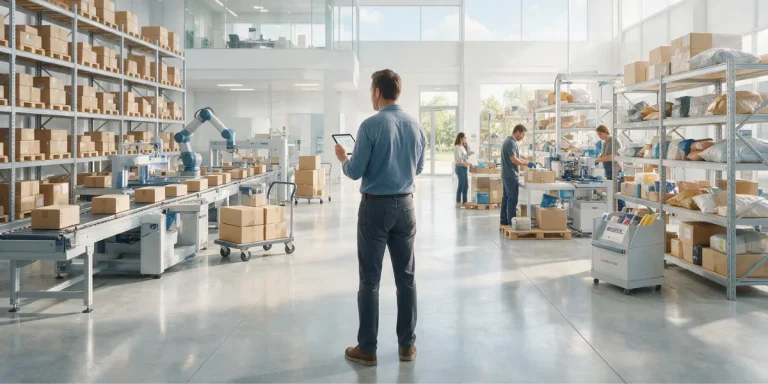
With the growth of e-commerce, one of the biggest challenges for businesses is managing warehousing and logistics processes. Proper product storage, quick preparation and packaging of orders, and reliable delivery to the customer directly impact customer satisfaction. At this point, businesses face two main options: Fulfillment Depot And traditional warehouse management. While both methods offer product storage, they differ significantly in terms of services, cost structures, and operational advantages. Let's examine the differences between these two types of warehouses in detail.
What does a fulfillment warehouse offer, and what does a traditional warehouse not offer?
These are modern logistics centers where products are not only stored but also orders are prepared and packaged, shipping integrations are carried out, and return processes are managed.“What is a fulfillment depot?”This answers the question, "How do we store goods?" Traditional warehouses generally focus solely on storing products. Processes such as order preparation, packaging, and shipping are mostly the responsibility of the business itself or are handled by external services.
The advantages offered by fulfillment depots can be listed as follows:
- Orders are automatically entered into the system and prepared.
- Real-time inventory tracking and reporting with barcode systems.
- Professional packaging services and brand-specific packaging.
- Fast and cost-effective shipping thanks to cargo integration.
- Professional management of return and exchange processes.
- Scalable warehouse and workforce support during campaign periods.
- Automated warehouse solutions by minimizing the error rate
The features that are not present in traditional warehouse management are as follows:
- Order preparation and shipping support
- Digital integration and automated reporting
- Professional packaging service
- Directly contributing to customer experience.
One of the most important differences of fulfillment warehouses is their full integration with e-commerce platforms. Thanks to systems that can directly connect with marketplaces like Trendyol, Hepsiburada, Amazon, or Shopify, orders are automatically sent to the warehouse and the preparation process begins. This eliminates the need for manual processing and minimizes the risk of errors. Traditional warehouse management, on the other hand, often relies on manual entries, leading to synchronization problems in stock and order management. This can result in both order delays and incorrect product shipments.
Order Preparation and Packaging Processes
The fulfillment system offers significant advantages in order preparation and packaging processes. Products are stored on barcode-based shelving systems, automatically prepared upon receiving an order, and professionally packaged. This ensures both speed and accuracy. Furthermore, special box and packaging options are offered for companies wishing to strengthen their brand image.
In traditional warehouses, order fulfillment is entirely dependent on the company's own personnel. This increases both labor costs and the margin of error. In fulfillment centers, packaging is not limited to simply putting the product in a box; details that enhance the customer experience can also be added. For example, brand-specific boxes, promotional brochures, or gift notes are professionally prepared and added to the package. This creates a strong brand image that increases customer loyalty. In traditional warehouses, such additional services are generally not available; packaging is implemented as a standard process, and personalization options are limited.
Cost Comparison: Which is More Affordable?
At first glance, traditional warehouse rental costs may seem lower than fulfillment warehouses. However, a detailed calculation changes the picture. This is because traditional warehouses incur additional costs such as personnel expenses, packaging materials, shipping agreements, and inventory management software.
In fulfillment warehouses, these costs are presented as a single package. The business only pays for the space it uses and the processing it handles. If the order volume is above a certain level, the fulfillment model can provide an advantage in total operational costs. For low-volume businesses, it is recommended to conduct a cost analysis.
A long-term cost analysis reveals the advantages of fulfillment warehouses. While traditional warehouses may seem attractive initially due to lower rental costs, over time, personnel expenses, packaging materials, insurance, security, and software costs increase the total burden. Fulfillment warehouses, on the other hand, offer these services in a single package, creating a scalable and transparent cost advantage. Especially during campaign periods when order volumes increase, traditional warehouses incur additional personnel and overtime costs, while fulfillment warehouses minimize this burden by providing additional capacity support.
Which is more suitable for which businesses?
Advantages of the fulfillment system, It is ideal for e-commerce businesses with high order volumes and a strong focus on customer experience. SMEs and marketplace sellers, in particular, who want to grow rapidly, will gain significant advantages with Fulfillment. Traditional warehouse management Fulfillment warehouses are more suitable for wholesale businesses with low order frequency or large firms that want to establish their own logistics infrastructure. The choice between fulfillment and traditional warehousing depends entirely on the business model, growth objectives, and logistics strategy. However, in today's rapidly growing e-commerce landscape, fulfillment warehouses stand out with their flexible structures and customer-focused solutions.
Fulfillment warehouses offer a critical advantage, especially for businesses engaged in e-export or actively selling on various marketplaces. Thanks to multi-platform integration, orders from different channels are consolidated in a single center and can be shipped the same day. In traditional warehouse management, this type of multi-channel synchronization is quite cumbersome and requires extra personnel. Therefore, for businesses that want to adapt to digitalization and prioritize customer experience, the fulfillment model is a much more strategic choice.